
Portable Rechargeable Lamp Sourcing Guide for Importers and OEM Buyers
A buyer in Rotterdam opens a carton of twelve portable rechargeable lamps, switches each one on, and watches three of them fade within twenty minutes...
 +86-18868663339 / +86-574-62067336


A buyer in Rotterdam opens a carton of twelve portable rechargeable lamps, switches each one on, and watches three of them fade within twenty minutes. The light was never the problem: the housing is clean, the finish matches the sample, the diffuser sits straight. What failed is the part nobody photographs, which is the battery, the charging board and the small protection circuit sitting behind them.
That is why a portable rechargeable lamp should be settled on four numbers before price is discussed: usable runtime at the brightness the customer will actually use, luminous output with colour quality, the certification pack for the destination market, and the order quantity per finish. Fix those four and quotations become comparable. Skip them and two suppliers can quote the same product name at prices 30 percent apart while shipping completely different products.
This guide is written for importers, wholesale distributors, retail brand owners and sourcing teams who buy decorative and functional lighting in volume. It explains how a cordless rechargeable lamp is built, where runtime claims come from, which specifications decide sell-through, how certification works for Europe, North America and Australia, and how OEM and ODM programmes are usually sequenced with a manufacturer.
Take the shade off and a portable rechargeable lamp is five subsystems stacked into a small housing. Each has a different failure profile, so they should be specified separately rather than treated as one item on a purchase order.
The protection board is where cost is most often removed quietly. A compliant pack cuts off discharge around 2.8 to 3.0 V per cell and limits charge to 4.2 V, and it includes a resettable fuse or dual MOSFET arrangement. Cheaper packs sometimes cut off closer to 2.5 V, which buys a few extra minutes of runtime on the test bench and costs hundreds of cycles over the product life. If you sell into hospitality, where lamps run nightly for years, this single component determines whether the second order arrives.
Charging is the second hidden variable. A 5 V / 1 A input is the common baseline and gives a full charge in three to eight hours depending on capacity, while a 5 V / 2 A input roughly halves that. Ask whether the lamp permits pass-through use while charging, because guests will do it anyway, and confirm that the charging board handles a full load plus charging without overheating the housing.
Capacity is usually quoted in milliamp-hours because it looks bigger, but watt-hours is the number that travels across cell formats. A 2,000 mAh cell at 3.7 V holds 7.4 Wh; a 5,000 mAh cell at 3.7 V holds 18.5 Wh. When a supplier quotes an 11.1 V pack, the milliamp-hour figure drops while the energy stays similar, so always convert before comparing.
| Cell configuration | Typical capacity | Energy | Runtime at reading output | Added weight | Typical fit |
|---|---|---|---|---|---|
| Single 18650 | 2,000 to 2,600 mAh | 7.4 to 9.6 Wh | 5 to 8 hours | 45 to 50 g | Compact bedside and shelf lamps |
| Dual 18650 | 4,000 to 5,200 mAh | 15 to 19 Wh | 10 to 14 hours | 90 to 100 g | Dining, restaurant and hotel table lamps |
| Single 21700 | 4,000 to 5,000 mAh | 15 to 18.5 Wh | 10 to 13 hours | 68 to 72 g | Slim metal bodies with limited internal height |
| Dual 21700 | 8,000 to 10,000 mAh | 30 to 37 Wh | 20 to 26 hours | 140 to 150 g | Large terrace and event models |
| Lithium polymer pouch | 3,000 to 6,000 mAh | 11 to 22 Wh | 8 to 16 hours | 55 to 110 g | Glass and ceramic designs with flat cavities |
Weight is not a side note. A tall ceramic or glass lamp with a light base and a 30 g cell pack tips easily on a restaurant table, and a heavy base plus a large pack makes the same lamp expensive to air freight. Ask for the assembled weight and the base diameter before approving the shape, then check that the centre of gravity sits low enough for a 15 degree table nudge without toppling.
Cost scales roughly linearly with energy. Moving from 2,000 mAh to 4,000 mAh typically adds one and a half to two and a half US dollars to the bill of materials at volume, while adding five or six hours of honest runtime that can support a materially higher retail price. That trade is usually worth taking for hospitality buyers and rarely worth taking for gift and promotional programmes where the lamp is an accent piece.
Runtime is the first specification a buyer tests in a showroom and the first one that generates returns. Most quoted figures are measured at the lowest dimming step, which is a legitimate measurement but rarely how a guest uses a hotel bedside lamp. To make quotations comparable, ask every supplier for the same two measurements at the same two brightness levels, and ask which level the packaging claim refers to. The chart below uses typical figures for 3.7 V lithium packs driving a constant-current LED load at roughly 85 percent driver efficiency. Values are planning estimates for comparison and should be confirmed on your own approved sample before the packaging artwork is signed off.
Bar length is proportional to runtime. Dark bars show full output; light bars show the lowest dimming step.
The first pattern worth noting is that doubling capacity from 2,000 to 4,000 mAh almost exactly doubles ambient runtime, which confirms the module is behaving predictably rather than losing energy to heat. The second pattern is the ratio between ambient and reading output, which holds at roughly three and a half to four times across every capacity. That ratio is the most useful single number in the whole negotiation, because it tells you what claim you can print once you know the full-output figure. A 6,000 mAh pack delivering 16 hours at full brightness is a strong, defensible statement for a hotel programme, while the same pack at ambient level promises nearly a week of evening light from one charge.
Weight and charging time grow alongside capacity, and both affect how the product is perceived rather than how it performs. A 21700 double pack adds around 150 g to a lamp, which makes a metal reading lamp feel substantial and makes a small acrylic accent lamp feel hollow when the diffuser rattles against the cell holder. Charge time grows linearly with capacity at a fixed input current, so a 6,000 mAh pack on a 5 V / 1 A input needs roughly eight hours, which is fine overnight but awkward in a restaurant where lamps are recharged during service preparation. Specifying a 5 V / 2 A board solves that at low cost.
Two further checks will save arguments later. Ask for a discharge curve at room temperature and a second curve near freezing if you sell into northern Europe, because usable capacity typically drops 15 to 25 percent in cold conditions and a terrace lamp rated for winter use needs headroom. Then confirm the low-voltage cut-off and the standby drain, since a lamp that loses 5 percent of its charge per week sitting in a warehouse will be flat on arrival after a slow sea freight cycle. Both are small details, and both appear in the first customer complaint when they are wrong.
Once the battery is settled, the optical package determines whether the product feels premium in the hand. The table below covers the parameters worth writing into a purchase specification, with realistic targets for decorative and functional rechargeable lamps.
| Parameter | Practical target | Why it matters commercially |
|---|---|---|
| Luminous flux | 150 to 300 lm ambient, 400 to 600 lm reading | Under 150 lm fails as a reading lamp; over 600 lm drains the cell quickly |
| Correlated colour temperature | 2700 K or 3000 K warm, 4000 K neutral | 3000 K is the safest default for hospitality and residential |
| Colour rendering index | At least 80, preferably 90 | High CRI keeps ceramic glazes, wood grain and food looking correct |
| Flicker depth | Under 8 percent, frequency above 1 kHz or DC driver | Visible flicker is picked up instantly by phone cameras and by guests |
| Dimming range | Three-step or stepless, lowest step under 5 percent | A low night step is the feature hotel buyers test first |
| Beam angle | 100 to 120 degrees with frosted diffuser | Wide angles suit table glow, narrow angles suit reading pools |
| Glare control | Recessed emitter or double diffuser | Bare emitters at eye level look cheap regardless of housing quality |
| Battery indicator | Four-step LED or single low-battery warning | Reduces "dead on arrival" complaints in hotel use |
Flicker deserves its own conversation because it is invisible in a catalogue and obvious in a room. A driver that regulates current cleanly will show no banding when filmed with a phone at 60 frames per second; a cheap driver will show rolling dark bars. Ask for a short phone video of the sample at three dimming levels and you will learn more than a datasheet can tell you.
Colour temperature is a merchandising decision as much as an engineering one. A 2700 K lamp flatters warm ceramic and rattan bodies, which is why most decorative ranges in this category sit there, while 4000 K reads as functional and suits desk and reading models. Offering the same body in two colour temperatures is common for contract buyers, but each variant needs its own certification listing and its own packaging barcode, so plan that at the quotation stage rather than after sampling.
The body of a portable rechargeable lamp controls both the price and the shelf appeal. Ceramic gives weight and glaze depth, but each shape needs a mould and each glaze batch carries a small colour tolerance, so ceramic programmes usually require a 300 to 500 piece minimum per finish. Metal spinning and pressing are cheaper to tool and hold tighter tolerances, which is why metal bodies dominate high-volume restaurant ranges. Glass offers optical clarity and a premium feel but needs careful packing and thicker walls around the battery cavity. Handwoven rattan, paper and hemp rope give texture and a strong natural story, with a plus or minus 5 mm dimensional tolerance that should be written into the drawing. Resin allows complex shapes such as mushroom and cube forms at low tooling cost.
Design direction matters as much as material. New Chinese ceramic, Japanese paper-woven, Nordic black and metal, American retro glass, industrial iron and light luxury dark green are all well-established looks in export catalogues, and each one implies a different diffuser, cable finish and dimmer style. For a brand programme the safest route is to start from an existing body that already has working tooling and modify the finish, the shade and the packaging rather than designing a new shell from zero.
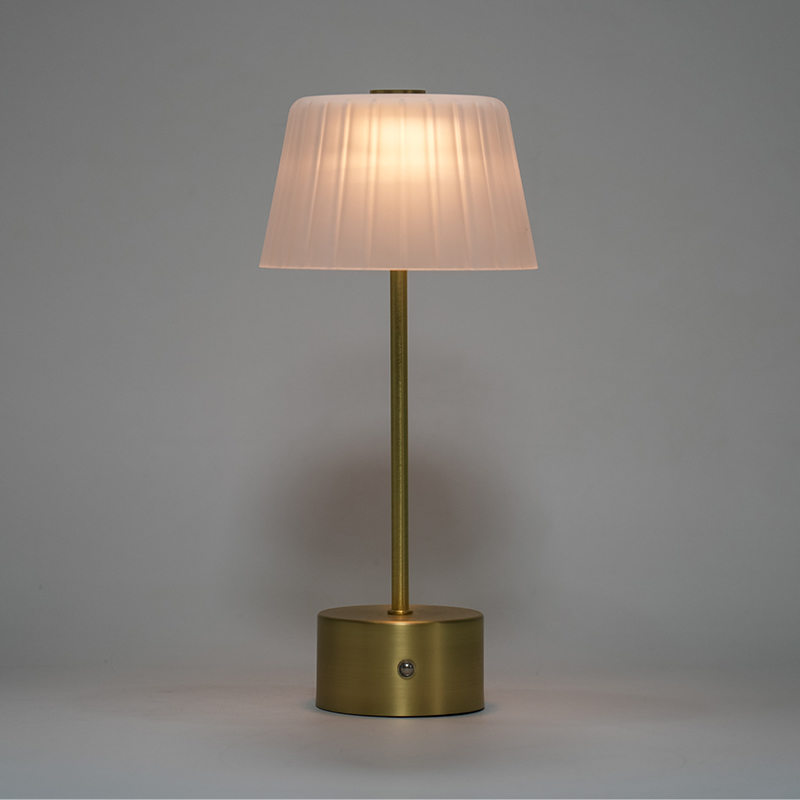 Gold Cone LED Rechargeable Table Lamp for OEM/ODM ProgrammesA gold metal cone lamp with rechargeable design, multiple safety protections, and versatile use for bedside, desk, or living room lighting.View Product →
Cordless models in a catalogue are worth studying for how they solve the charging question visually. A cone or cylinder body with a hidden USB-C port at the base keeps the silhouette clean while allowing a full recharge in a few hours, and it lets the same housing be sold in both corded and cordless versions for different markets.
Lithium battery lamps need two document sets: one for the electrical product and one for the battery as a dangerous good. Missing either will stop a shipment at the forwarder rather than at customs, which is the more expensive place to discover a gap.
| Market | Core documents | Notes for battery lamps |
|---|---|---|
| European Union | CE marking under LVD, EMC and RoHS; Ecodesign documentation; REACH declaration | Battery regulation obligations and WEEE registration apply; replaceable battery design is increasingly expected |
| United States | FCC Part 15 for the driver; retailer-required safety listing; California warning where applicable | Retail chains often require UL or ETL listing even where not legally mandated |
| Australia and New Zealand | RCM supplier declaration; electrical safety compliance | Battery labelling and child-resistant packaging rules for small cells |
| United Kingdom | UKCA marking with equivalent technical file | Separate from CE from the buyer's documentation perspective |
| All markets by air or sea | UN38.3 test summary, MSDS, 1.2 m drop test report, packing instruction declaration | Cells shipped inside equipment follow a different packing instruction than loose cells |
Cell-level safety testing to IEC 62133-2 is the document most often requested by European and Australian buyers, and it applies to the cell and pack rather than the finished lamp. Ask whether the certificate covers the exact cell model you are buying, because a report for a different capacity or a different factory line will not protect you in an audit.
Ecodesign rules also shape the design brief. Requirements around light source replaceability and energy information mean that a fully sealed lamp with a non-replaceable light engine becomes harder to place in the European market over time. Designing a battery compartment that a technician can open with a single screwdriver costs very little at the drawing stage and protects the product's market access for years. Documentation should also cover the packaging itself, since extended producer responsibility rules in several European countries require registration and reporting by the importer.
Most buyers arrive with a reference image, a target landed cost and a launch window. A working manufacturer will convert that into a sequenced programme rather than a single quotation, because ceramic, glass and handwoven bodies each add their own lead time before assembly even starts.
Minimum order quantities follow the material more than the electronics. Metal and resin bodies often start at 200 pieces per finish, ceramic at 300 to 500, and handwoven natural materials at 200 with a longer assembly time. Logo application can be laser etched on metal, silk screened on glass, or applied as a metal badge on ceramic, and each method has a different minimum and a different durability under cleaning. ODM routes avoid tooling entirely by using an existing body with a custom finish and packaging, which is often the fastest way to test a market before committing to a full OEM programme.
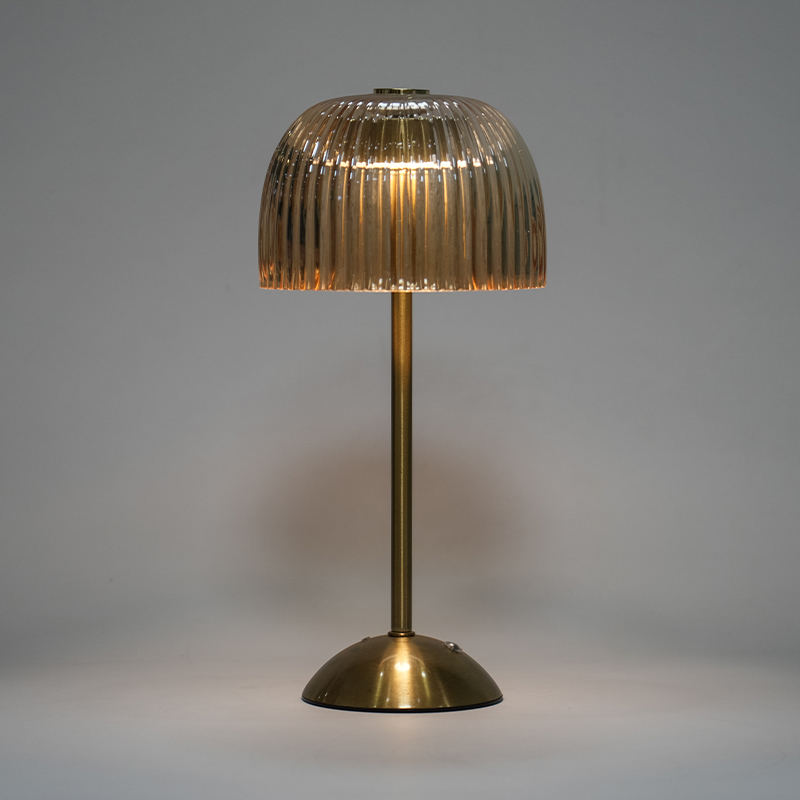 American Retro LED Charging Table Lamp for OEM/ODMA decorative golden metal lamp with hemispherical cover and slender stripes, offering stable round-base support for study, bedroom, or living room settings.View Product →
Retro and vintage shapes are a common starting point for first programmes because they carry a recognisable look, photograph well in lifestyle imagery, and accept a standard 18650 or 21700 pack without a new internal layout. That combination shortens the sampling cycle considerably.
The same lamp specification will not serve a hotel terrace and a bedside table. The table below pairs the buying scenario with the decision it forces on the specification sheet.
Where the lamp will live
|
What that forces in the specification
|
One practical test settles most of these questions in a single afternoon. Place the sample on the surface it will actually be used on, switch it to the lowest step, and sit two metres away for fifteen minutes. If the light irritates at that distance, no specification sheet will fix it, and the same applies to the highest step if the lamp is meant for reading.
Rechargeable is rarely the only option on the table. Comparing it against corded, alkaline and power-bank solutions makes the trade-offs explicit for the buyer who is still deciding.
| Option | Unit cost effect | Energy per fill | Weight | Placement freedom | Best fit |
|---|---|---|---|---|---|
| Built-in lithium rechargeable | Highest | 6 to 60 hours depending on capacity | 45 to 150 g added | Full, no cable needed | Hospitality, terrace, contract |
| Corded LED table lamp | Lowest | Continuous while plugged in | No battery weight | Limited to socket positions | Fixed residential and office use |
| Alkaline battery lamp | Low | 10 to 20 hours per set | 30 to 60 g added | Full, but consumable cost | Low-price promotional ranges |
| USB power bank lamp | Medium | Depends on external bank | Variable | Full, but two items to manage | Camping and short-term events |
Alkaline lamps look cheap at the sample stage and expensive in the second season, because guests replace cells and staff spend time doing it. Corded lamps remain the correct choice wherever a socket exists, since they avoid the battery entirely and last for years. The rechargeable option wins specifically where the room layout cannot accept a cable run, where the lamp must move between indoor and outdoor settings, or where the absence of a cable is itself part of the design.
Field failures in this category cluster around four components, and most are visible during a factory inspection if the buyer knows what to check.
Give buyers a short maintenance note to pass to end users: charge fully before first use, recharge every three months in storage, wipe ceramic and glass with a damp cloth rather than solvent, and keep the port cover closed in outdoor use. These four lines reduce warranty claims more than most engineering changes, because they remove the misuse cases that generate returns.
What runtime can I realistically claim on packaging?Claim the full-output figure, not the lowest-step figure. A 4,000 mAh lamp typically gives around 11 hours at full output and around 40 hours at the lowest step, so printing the lower number is honest and still competitive. If you want a headline claim, print both, because buyers increasingly check the second one. |
Is a replaceable battery mandatory for Europe?Requirements are tightening and a user-replaceable or technician-replaceable design is the safer planning assumption. Beyond regulation, replaceability extends the sellable life of the lamp, which matters for contract buyers who expect a five-year service horizon. |
What is a normal minimum order for a custom finish?Roughly 200 pieces per finish for metal and resin bodies, 300 to 500 for ceramic, and about 200 for handwoven natural materials. Using an existing body with a custom finish and packaging is the standard way to test a market below those quantities. |
Can the lamp be used while it is charging?Many models allow it and some do not, and the difference sits in the charging board rather than the cell. Ask explicitly, because guests and restaurant staff will use the lamp while plugged in regardless of the instruction leaflet, and a board that cannot handle simultaneous load will run hot. |
How do I verify the battery is genuinely the capacity quoted?Ask for a discharge test report naming the cell model, then run your own timed test on two units at full output. A 4,000 mAh pack at full output should hold within about 10 percent of the quoted hours; a pack that falls well short is usually a lower-capacity cell with a rewritten label. |
Which colour temperature should I order first?3000 K is the safest first order for decorative and hospitality ranges because it flatters ceramic, wood and woven materials. Add 4000 K as a second variant for reading and desk models, and remember that each variant needs its own listing and packaging code. |
What documentation does air freight require?Expect a UN38.3 test summary, a material safety data sheet, a 1.2 m drop test report and a packing instruction declaration for cells contained in equipment. Sea freight needs the same battery documents, so they should be prepared once and reused rather than rebuilt for each order. |
The work that separates a smooth programme from a difficult one happens before the first purchase order: cell capacity stated in watt-hours, runtime quoted at both brightness levels, certification documents named by number, minimum quantity stated per finish, and the destination market written into the brief. With those five items in hand, quotations from different suppliers describe the same product and can be compared line by line instead of by headline price.
For buyers sourcing from a specialist manufacturer, the fastest route is to send a reference image, the intended use scenario and a target landed cost, then ask for a proposal that covers both an existing body and a modified version. Comparing those two options in the same response usually reveals whether tooling is worth the investment or whether a finish change will reach the market faster.
Browse the cordless LED rangeSee the rechargeable table lamp models currently in production, including cone, vintage and metal body styles with built-in lithium packs. |
Send a specification for quotationShare your market, runtime target, finish direction and annual volume, and ask for a line-by-line quotation with certification scope included. |
A buyer in Rotterdam opens a carton of twelve portable rechargeable lamps, switches each one on, and watches three of them fade within twenty minutes...
An importer in Rotterdam opens a container of 3,000 bedside lamps and finds 180 cracked glass shades. The bases are fine, the wiring passed inspectio...
Two containers of the same decorative table lamp leave the same factory, and only the socket label changes: E27 for a German importer, E26 for a US w...
Predstavte si, že kupujete 2 000 lámp na rekonštrukciu butikového hotela a v špecifikácii sa uvádza iba „žiarivka vs žiarovka“. Prvou otázkou ni...

 Č.

Autorské práva © Yuyao Baolong Electrical Appliance Co., Ltd. Všetky práva vyhradené.

+86-18868663339
+86-574-62067336
